
When selecting timber for beams, joists, or any application where wood must span between supports, understanding modulus of rupture (MOR) is crucial. While tensile strength and compression strength measure resistance to pulling and crushing forces respectively, modulus of rupture quantifies wood’s ability to resist bending. This guide explains what MOR means, how it’s measured, and why it matters for structural timber selection.
What Is Modulus of Rupture?
Modulus of rupture (MOR), also called bending strength or flexural strength, measures the maximum load-carrying capacity of a beam before failure. When a timber beam spans between two supports and carries weight, it bends—creating compression forces on the top surface and tension forces on the bottom surface. MOR quantifies the combined resistance to these simultaneous tension and compression stresses.
Despite its name suggesting “rupture,” MOR is not technically a true stress value. The calculation uses basic beam theory that remains valid only up to the elastic limit, yet engineers continue loading the beam until failure to obtain MOR. This makes MOR a conventional strength indicator rather than a precisely defined material property. Nevertheless, it serves as the most widely used criterion for comparing wood species’ bending performance and designing structural beams.
How Modulus of Rupture Is Measured
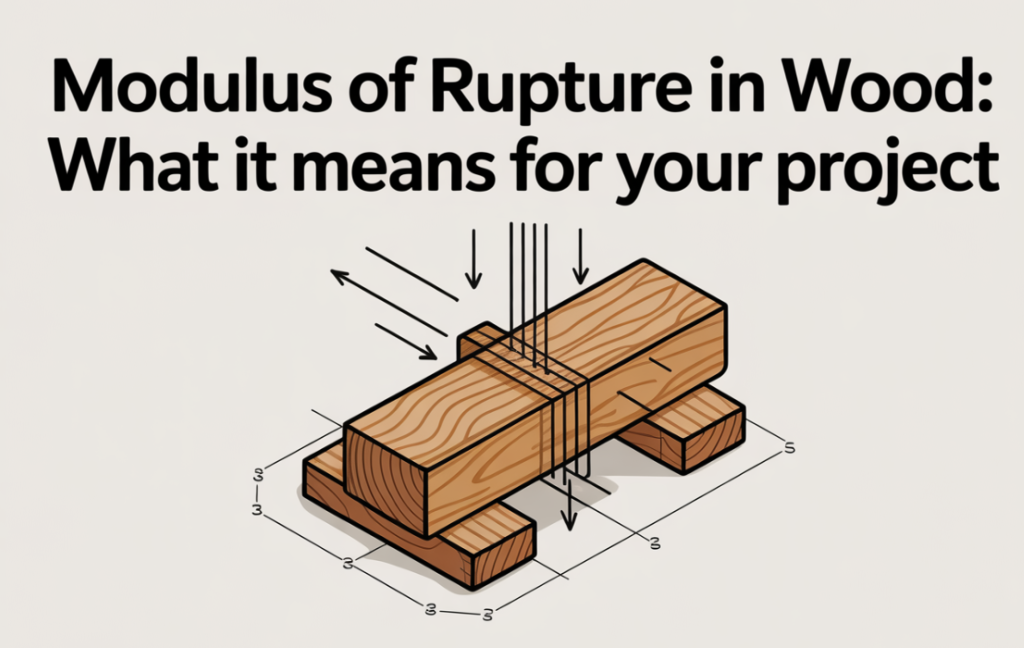
MOR testing follows a standardized procedure that applies load at the center of a simply-supported beam until failure occurs. The test specimen—typically a small, clear, straight-grained sample—rests on two supports spaced 14 times the beam depth apart (a span-to-depth ratio of 14:1). A loading head applies force at the beam’s midpoint while instruments measure deflection and load.
As load increases, the beam deflects and the wood fibers on the tension face (bottom) begin stretching while fibers on the compression face (top) compress. Eventually, the beam fails, typically through tension failure on the bottom face where fibers rupture, or less commonly through compression crushing on the top. The maximum load achieved during the test is used to calculate MOR using the standard beam bending formula:
MOR = (3 × P × L) / (2 × b × d²)
Where P is the maximum load, L is the span between supports, b is the beam width, and d is the beam depth. This formula yields the outer fiber stress at failure, reported in megapascals (MPa) or pounds per square inch (psi).
MOR vs. Other Strength Properties
Understanding how modulus of rupture relates to other wood strength properties clarifies when each property governs structural design.
MOR vs. Tensile Strength
Tensile strength measures wood’s resistance to pure pulling forces along the grain, while MOR measures bending resistance involving both tension and compression. Wood is inherently stronger in pure tension than in bending because bending introduces complexity—one face experiences tension while the opposite face experiences compression.
Typically, MOR values fall 20-40% below pure tensile strength values. For White Oak, tensile strength parallel to grain exceeds 100 MPa, while MOR measures approximately 105 MPa. This similarity reflects that bending failures usually initiate on the tension face, making MOR primarily limited by tensile capacity rather than compression strength.
Because tensile strength is difficult to measure accurately and relatively few species have comprehensive tension data, engineers commonly use MOR as a conservative substitute for tensile strength in applications involving clear, straight-grained wood.
MOR vs. Compression Strength
Compression strength measures resistance to crushing forces, and wood is generally weaker in compression than tension. However, MOR typically exceeds compression strength because the wood fails on the tension side before the compression side crushes.
White Oak demonstrates compression parallel to grain strength of 51.1 MPa but achieves MOR of 105 MPa—approximately double the compression capacity. This relationship means that beams properly sized for bending loads inherently have excess capacity to resist pure compression forces when used as posts or columns.
The exception occurs in very short, deep beams where compression crushing on the top face can occur before tensile failure develops. In such cases, compression strength rather than MOR may govern design, though this scenario rarely occurs in typical structural applications.
MOR vs. Shear Strength
Shear strength measures wood’s resistance to forces that cause internal layers to slide past each other parallel to grain. While MOR governs beam capacity in the center third of a span where bending moment is highest, shear strength typically governs near supports where shear forces peak.
Shear strength is generally the weakest mechanical property in wood, ranging from 10-20% of MOR values. White Oak’s shear strength of approximately 13 MPa contrasts sharply with its 105 MPa MOR. This disparity explains why beams sometimes fail through horizontal splitting near supports even when the center section appears adequately sized for bending.
Proper beam design must verify both bending (using MOR) at midspan and shear capacity near supports. Increasing beam depth improves bending capacity dramatically but provides minimal shear improvement, sometimes necessitating wider beams or additional bearing length to prevent shear failures.
Modulus of Elasticity (MOE): MOR’s Essential Companion
Modulus of elasticity (MOE) always accompanies MOR data because it quantifies beam stiffness—how much a beam deflects under load. While MOR indicates the ultimate load causing failure, MOE determines deflection at working loads well below failure stress.
For most residential and commercial applications, deflection limits rather than strength govern beam sizing. Building codes typically restrict deflections to L/360 (span divided by 360) for floors and L/240 for roof members to prevent cracking in finishes, door binding, or unpleasant springy floors.
A species with high MOR but low MOE may satisfy strength requirements yet deflect excessively under normal loads. Douglas Fir exemplifies excellent balance with MOR of 85 MPa and MOE of 13.4 GPa, providing both adequate strength and stiffness. Radiata Pine achieves reasonable MOR (76 MPa) but lower MOE (11.2 GPa), sometimes requiring deeper joists to meet deflection criteria despite adequate strength.
The MOR-to-MOE ratio indicates wood’s relative strength versus stiffness. Species with high ratios offer good strength per unit stiffness, while low ratios suggest the wood will deflect considerably before approaching failure—often desirable for providing visual warning before catastrophic failure.
Factors Affecting Modulus of Rupture
Multiple variables influence MOR values, and understanding these factors helps explain variations between laboratory test results and real-world timber performance.
Wood Species and Density
MOR correlates strongly with wood density and specific gravity. Dense hardwoods like Spotted Gum (MOR ~127 MPa) and Ironbark (MOR ~140 MPa) substantially exceed softwoods like Radiata Pine (MOR 76 MPa). This relationship exists because denser wood contains more cell wall material per unit volume, providing greater resistance to the tension and compression stresses that develop during bending.
Among Australian structural timbers, hardwoods from native forests typically achieve MOR values 50-100% higher than plantation softwoods. However, plantation hardwoods like young Spotted Gum may exhibit MOR values intermediate between softwoods and old-growth hardwoods due to higher proportions of juvenile wood with larger growth rings and lower density.
Moisture Content
Moisture content dramatically affects MOR. As wood dries below the fiber saturation point (approximately 28-30% moisture content), MOR increases substantially. Wood at 12% moisture content—standard for interior applications—exhibits 40-71% higher MOR than green (freshly cut) timber.
Southern Yellow Pine’s MOR increases from 50 MPa when green to 88 MPa at 12% moisture content—a 76% strength gain through drying. This moisture-strength relationship makes proper seasoning critical for structural timber. Using inadequately dried timber results in strength below design assumptions, potentially leading to excessive deflection or failure.
Conversely, wood exposed to high humidity environments loses strength as moisture content increases. Exterior applications in wet climates require design modifications accounting for reduced MOR at elevated moisture content.
Grain Direction and Slope
MOR values assume straight grain parallel to the beam length. Real timber often contains grain that slopes away from the member axis—called slope of grain—which significantly reduces bending strength. As detailed in wood grain direction and strength, even modest grain slope causes substantial strength reductions.
A slope of grain of 1:20 (grain deviating 1 unit for every 20 units along the member) reduces MOR by 10-15%. At 1:10 slope, reductions may exceed 30%. Knots exacerbate this problem by creating severe local grain deviation around the knot perimeter, introducing stress concentrations that initiate failure at loads well below clear wood capacity.
Structural timber grading systems account for these natural defects by grouping lumber into grades with characteristic strength values below clear wood MOR. F17 hardwood (MOR ~68 MPa characteristic strength) contains small knots and grain deviation, while F27 hardwood (MOR ~108 MPa characteristic) approaches clear wood strength through stricter limits on defects.
Loading Rate and Duration
MOR values from standard tests reflect loading applied over several minutes until failure. Real structures experience various loading rates and durations, from sudden impact loads to continuous dead loads sustained for decades. Loading rate significantly affects apparent MOR—rapid loading increases MOR by 10-20% compared to standard test rates, while very slow loading reduces MOR.
More importantly, sustained loading reduces effective MOR through creep—time-dependent deformation where wood continues deflecting under constant stress. Australian timber design standard AS1720 incorporates duration of load factors ranging from 1.15 for short-term loads (wind, snow) to 0.57 for permanent dead loads. These factors acknowledge that wood can sustain much higher stresses briefly than indefinitely.
Temperature and Chemical Exposure
Elevated temperatures reduce MOR. Wood at 150°F (65°C) retains only 80-90% of room temperature strength. This matters for timbers near heating equipment, in hot roof spaces, or exposed to prolonged direct sunlight where surface temperatures substantially exceed ambient conditions.
Chemical treatments affect MOR variably. Fire retardants sometimes reduce MOR by 10-20%, while preservative treatments (CCA, ACQ) typically cause minimal strength loss. However, the treatment process—particularly high-temperature kiln-drying after pressure treatment—can induce checking and splitting that reduces effective bending capacity more than the chemical itself.
Practical Applications of MOR
Understanding MOR guides timber selection for applications where bending is the primary structural concern.
Floor Joists and Ceiling Joists
Floor joists carry distributed loads from flooring, furniture, and occupants while spanning between supporting walls or beams. MOR governs joist capacity at the center of the span where bending moment peaks. Australian residential construction commonly uses F7 MGP12 treated pine joists (90mm × 45mm) at 450mm centers for spans up to 2.4-2.7 meters, or larger sections (190mm × 45mm) for longer spans.
Ceiling joists carry lighter loads than floors but often span greater distances. The reduced loads allow lighter framing, but deflection limits become more restrictive to prevent ceiling cracking. MOE often governs ceiling joist sizing more than MOR because excessive deflection damages plasterboard joints even when stresses remain well below failure levels.
Deck Beams and Headers
Deck beams carry concentrated loads from supporting joists while spanning between posts. These members experience higher stresses than typical floor joists, often requiring larger sections or stronger species. F17 hardwood beams (190mm × 45mm) commonly span 2.4-3.0 meters while supporting typical deck joist layouts, while larger spans necessitate deeper sections like 240mm × 45mm or parallel beam configurations.
Headers above doors and windows in wall framing carry roof and floor loads while spanning openings. Short, heavily loaded headers may require engineered lumber products (LVL, glulam) with MOR values 30-50% higher than solid timber, allowing equivalent capacity in shallower sections that fit within standard wall depths.
Rafters and Roof Framing
Rafters resist bending from roof loads (self-weight, wind, occasional maintenance loads) while spanning between ridge beams and external walls. Australian residential roofing typically uses F5 or F7 treated pine rafters (90mm × 45mm) at 600-900mm centers depending on roof pitch, span, and roofing material weight.
Collar ties and ridge beams in cathedral ceilings function as beams supporting rafters, making MOR critical for these applications. Exposed timber beams in architecturally significant spaces often use select-grade hardwoods (F27-F34) to minimize section sizes while meeting both structural and aesthetic requirements.
Timber Furniture and Shelving
Though not typically governed by building codes, furniture applications frequently rely on MOR. A bookshelf spanning 900mm must support concentrated loads from books without excessive sag. A 19mm thick shelf in Radiata Pine (MOR 76 MPa) may deflect noticeably with heavy books, while a similar shelf in Blackbutt hardwood (MOR ~100 MPa) performs better despite identical dimensions.
Table legs and chair frames combine bending and compression loads, with MOR governing thin sections subject to lateral loads. Furniture makers traditionally select species balancing adequate MOR with workability, cost, and aesthetic appeal—Tasmanian Oak, Jarrah, and imported species like Oak offering good combinations of these properties.
Comparing MOR Across Common Australian Timbers
Different species offer varying bending capacities, influencing selection for specific applications:
High-Strength Hardwoods:
- Ironbark: 140-150 MPa – Excellent for heavily loaded beams, may be difficult to work
- Spotted Gum: 120-130 MPa – Popular for structural and exposed beams
- Grey Gum: 115-125 MPa – Strong and durable for external applications
- Blackbutt: 100-110 MPa – Good strength-to-weight ratio, lighter than Ironbark
- White Oak: 105 MPa – Reliable for general structural beams
Medium-Strength Timbers:
- Tasmanian Oak: 90-95 MPa – Popular for floor joists and general framing
- Southern Yellow Pine: 90 MPa – Strong softwood comparable to some hardwoods
- Douglas Fir: 85 MPa – Excellent stiffness with good strength
Plantation Softwoods:
- Radiata Pine (F7): 76 MPa – Adequate for residential framing when properly graded
- Cypress Pine: 73 MPa – Naturally durable, suitable for exterior applications
Design Considerations and Safety Factors
Structural design never uses full MOR test values. AS1720 incorporates multiple safety factors accounting for timber variability, load uncertainties, and consequences of failure. Characteristic MOR values represent the fifth percentile of the species population—95% of samples exceed this strength.
Design MOR values further reduce characteristic strengths by factors accounting for load duration (0.57-1.15), moisture service conditions (0.8-1.0), and specific application factors. The result is that allowable bending stresses are typically 20-35% of average tested MOR, providing substantial safety margins.
For DIY projects, consulting published span tables eliminates the need for complex calculations. These tables, based on AS1720 design procedures, specify maximum spans for standard joist sizes and spacings. When project requirements exceed span table limits, engaging a structural engineer ensures proper beam sizing and detailing.
Conclusion
Modulus of rupture serves as the primary indicator of wood’s bending strength, governing the design of beams, joists, rafters, and all applications where timber spans between supports. Understanding how MOR differs from tensile, compression, and shear strength, recognizing the critical partnership between MOR and MOE for controlling deflection, and appreciating factors like species, moisture content, and grain direction that influence MOR empowers informed timber selection.
Whether you’re framing a deck, installing floor joists, or designing exposed beams for a renovation, properly accounting for MOR ensures your timber structures safely support their intended loads while meeting deflection expectations. For projects beyond the scope of standard span tables, consulting Australian timber design standards or engaging qualified professionals ensures compliance with all structural requirements and delivers structures that perform reliably for decades.
Recent Posts
Building a beautiful and durable deck requires careful planning and execution, especially when working with composite decking. This guide will walk you through the essential steps to achieve...
A comprehensive guide to achieving flawless miter joints when working with composite decking. This article delves into the intricacies of miter cuts, essential tools, and expert techniques to ensure...