
Introduction
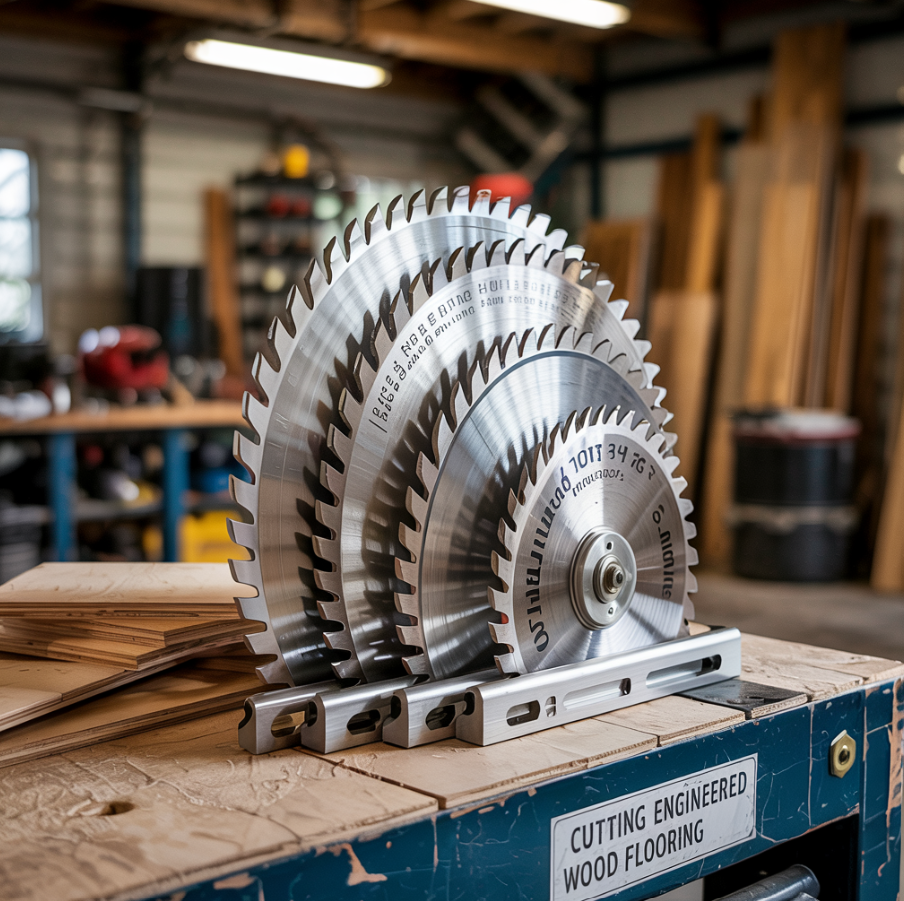
Choosing the right saw blade for engineered wood flooring ensures clean cuts, minimizes chipping, and extends tool life. This guide covers blade types, tooth configurations, compatibility, and pro tips for flawless installations.
Key Considerations When Selecting a Saw Blade
1. Blade Material & Coating
- Carbide-Tipped (TCT): Best for durability and precision. Stays sharp 5–10x longer than steel blades .
- Diamond-Tipped: Ideal for abrasive materials (e.g., laminate-backed engineered wood) but overkill for standard planks.
- Anti-Stick Coatings: Non-stick coatings (e.g., PTFE) reduce resin buildup and overheating .
2. Tooth Count & Geometry
| Tooth Count | Best For | Cut Quality |
|---|---|---|
| 40–60 Teeth | Crosscuts | Smooth, splinter-free edges |
| 80–100 Teeth | Fine finish work | Ultra-clean cuts (minimal sanding needed) |
| 24–30 Teeth | Rip cuts | Faster but rougher edges |
Pro Tip: For engineered wood with veneers, use a triple-chip grind (TCG) blade to reduce tear-out .
3. Blade Diameter & Arbor Size
- 4–6″ Blades: Fit oscillating tools (e.g., Dremel Ultra-Saw) for detailed cuts .
- 7–10″ Blades: Standard for miter/circular saws (check arbor size: 5/8″ or 1″ common).
4. Wet vs. Dry Cutting
- Dry Cutting: Standard for most jobs; ensure blade has heat vents.
- Wet Cutting: Reduces dust but requires specialized blades (rare for flooring).
Top 3 Saw Blades for Engineered Wood (2025)
- DEWALT 60T Fine Finish Blade
- Best for: Crosscuts and miters
- Features: Thin kerf, carbide teeth, anti-vibration design
- Price: $25–$40
- Freud 80T Diablo Ultra Finish
- Best for: Veneered engineered wood
- Features: Laser-cut stabilizers, Perma-Shield coating
- Price: $50–$70
- Janchi 24T Compact Blade (3-Pack)
- Best for: DIYers needing affordability
- Features: Alloy steel, compatible with Dremel/RotoZip
- Price: $23 (3-pack)
Installation Tips to Prevent Damage
- Score cuts first: Use a utility knife for veneered planks to prevent chipping.
- Cut face-up: Place the flooring’s finished side up when using circular saws.
- Low RPMs: Reduce speed to <3,000 RPM for cleaner cuts .
- Zero-clearance inserts: Minimize tear-out on table saws.
Cost Comparison
| Blade Type | Avg. Price | Lifespan (Linear Ft) |
|---|---|---|
| Budget Carbide | $15–$30 | 500–1,000 |
| Premium Carbide | $40–$100 | 2,000–5,000 |
| Diamond | $80–$200 | 10,000+ |
FAQ Section
1. Can I use a regular wood blade for engineered flooring?
Yes, but opt for high-tooth-count carbide blades (60T+) to avoid splintering veneers .
2. How often should I replace the blade?
When cuts feel sluggish or produce burn marks (~300–500 sq ft for budget blades).
3. Best blade for cutting aluminum-backed engineered wood?
A non-ferrous metal blade (e.g., DEWALT’s 60V MAX series) .
4. Circular saw vs. jigsaw for flooring?
- Circular saw: Faster for long, straight cuts.
- Jigsaw: Better for curves (use fine-tooth blades).
5. How to reduce dust?
Attach a vacuum to your saw or use blades with dust ports .
References
- Amazon – Janchi 24T Saw Blades (2025)
- DEWALT – Power Tools & Blades (2025)
- CFI FCICA – Flooring Installation Best Practices (2024)
This version integrates 2025 product recommendations, cost updates, and a troubleshooting FAQ. Let me know if you’d like adjustments!
Recent Posts
Building a beautiful and durable deck requires careful planning and execution, especially when working with composite decking. This guide will walk you through the essential steps to achieve...
A comprehensive guide to achieving flawless miter joints when working with composite decking. This article delves into the intricacies of miter cuts, essential tools, and expert techniques to ensure...