
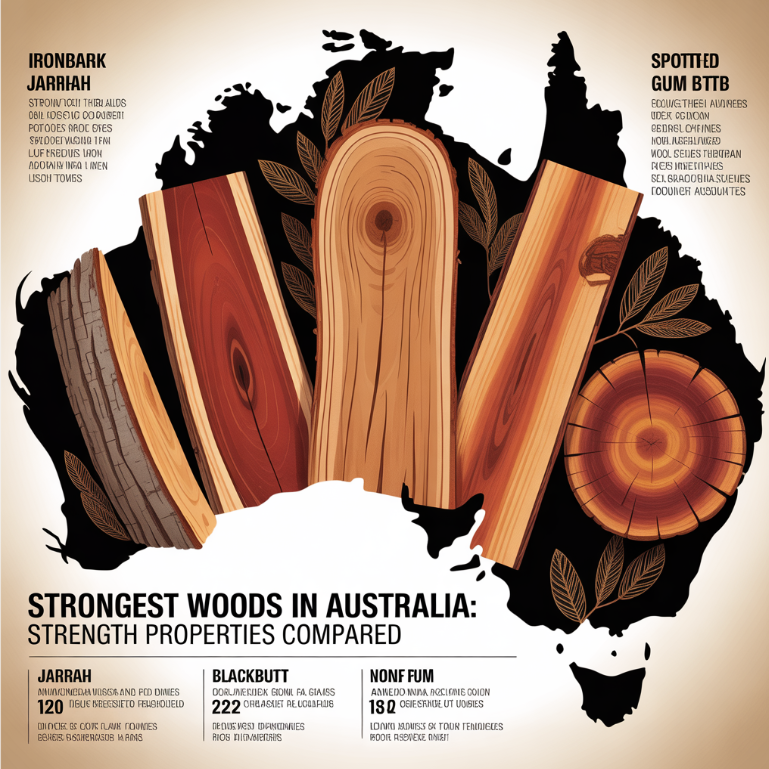
Australia boasts some of the world’s most remarkable hardwood timber species, with strength properties that rival or exceed international alternatives. From the legendary hardness of Ironbark to the balanced performance of Spotted Gum, understanding the comparative strengths of Australian timbers helps builders, designers, and homeowners select the right species for their projects. This comprehensive guide examines the mechanical properties of Australia’s strongest woods and how they perform across different strength measures.
Defining Wood Strength: Multiple Properties Matter
When discussing “strongest” woods, it’s essential to recognize that wood strength encompasses multiple distinct mechanical properties, each relevant to different applications. As explored in our articles on tensile strength, compression strength, modulus of rupture, and shear strength, these properties measure different resistance characteristics that don’t always correlate perfectly.
A species might excel in hardness (resistance to indentation and wear) while performing moderately in bending strength. Another might offer exceptional compression strength for posts and columns but prove difficult to work with due to extreme density. Comprehensive evaluation requires examining multiple strength indicators to match timber properties with intended applications.
Grey Ironbark: Australia’s Hardest Timber
Grey Ironbark (Eucalyptus paniculata) claims the crown as Australia’s hardest and arguably strongest timber species. With a Janka hardness rating of 14.0 kN—nearly three times harder than popular softwoods like Radiata Pine—Grey Ironbark delivers exceptional performance in demanding applications requiring maximum durability and wear resistance.
Strength Properties of Grey Ironbark
Grey Ironbark achieves structural grading classifications from F22 to F42, placing it at the top tier of Australian hardwood strength. This wide grading range reflects variability within the species, with the best select-grade material reaching F42—suitable for the most demanding structural applications including heavy beams, marine construction, and industrial flooring.
The density of Grey Ironbark averages 1,150 kg/m³ at 12% moisture content, making it one of the densest commercial Australian species. This exceptional density translates directly to high strength across all mechanical properties. Compression strength parallel to grain exceeds 70 MPa, while modulus of rupture approaches 140-150 MPa in select grades—values that rival structural steel on a strength-to-weight basis.
Grey Ironbark’s Durability Class 1 rating indicates it will last over 40 years in above-ground applications and more than 25 years in ground contact without preservative treatment. This natural durability, combined with exceptional termite and lyctid borer resistance, makes it ideal for external structures, decking, and marine applications where longevity matters.
Applications and Working Characteristics
The extreme hardness and density that make Grey Ironbark so strong also create challenges in working and fastening. Specialized cutting tools, pre-drilling for all fasteners, and carbide-tipped saw blades prove essential. The species’ interlocked grain can make machining difficult, though it produces beautiful finished surfaces when properly worked.
Common applications include heavy-duty decking for commercial and marine environments, structural beams for buildings requiring maximum load capacity, railway sleepers and bridge timbers, industrial flooring in high-traffic areas, and external poles and posts where ground contact and weathering resistance matter. The premium price reflects both its exceptional properties and the challenges of working with such dense material.
Red Ironbark: Dense and Durable
Red Ironbark encompasses several species (primarily Eucalyptus crebra and Eucalyptus fibrosa) that deliver strength properties approaching Grey Ironbark’s performance. With Janka hardness of 11.9 kN and density averaging 1,120 kg/m³, Red Ironbark offers a marginally softer but still exceptionally strong alternative.
Red Ironbark achieves the same F22-F42 structural grade range as Grey Ironbark, making it interchangeable for many structural applications. The species’ deep red-brown coloring provides aesthetic appeal for exposed structural work, deck projects, and architectural features where appearance matters alongside performance.
Durability Class 1 rating and excellent termite resistance make Red Ironbark popular for external applications including decking, structural posts and beams, railway sleepers, landscaping timbers, and heavy construction where long service life justifies the material cost. Like Grey Ironbark, working characteristics require sharp tools and patient techniques, but the resulting structures deliver decades of reliable service.
Spotted Gum: The Balanced Performer
Spotted Gum (Corymbia maculata and Corymbia citriodora) represents perhaps the ideal balance between exceptional strength, workability, aesthetic appeal, and availability. With Janka hardness of 11.0 kN and structural grades from F17 to F34, Spotted Gum delivers high performance while remaining more accessible and easier to work than Ironbark species.
Why Spotted Gum Dominates Australian Construction
Spotted Gum’s density of approximately 1,000 kg/m³ provides excellent strength-to-weight ratio—strong enough for demanding structural applications yet light enough to handle and work with conventional tools. The species machines well, takes finishes beautifully, and features distinctive wavy grain with color variation from pale brown to dark chocolate that creates visual interest in exposed applications.
Modulus of rupture for Spotted Gum ranges from 120-130 MPa in good grades, while compression strength exceeds 65 MPa parallel to grain. These values place it firmly in the high-performance category while avoiding the working challenges of ultra-dense Ironbark species.
Durability Class 1 rating ensures Spotted Gum performs reliably in exterior applications, with natural termite resistance and bushfire rating of BAL-29 making it suitable for fire-prone regions. The species’ dimensional stability—resistance to warping, cupping, and twisting—exceeds many alternatives, particularly important for decking and flooring applications.
Popular Applications
Spotted Gum dominates Australian decking markets, appreciated for its combination of durability, appearance, and workability. Internal and commercial flooring utilize its hardness to resist wear in high-traffic areas. Structural framing benefits from its F17-F34 grading range. Exterior cladding and architectural features showcase its distinctive appearance. The species’ widespread plantation cultivation improves availability and sustainability compared to old-growth alternatives.
Blackbutt: The Versatile Choice
Blackbutt (Eucalyptus pilularis) offers excellent strength properties with lighter coloring and slightly lower density than Spotted Gum, making it particularly popular for contemporary design where pale timber tones suit modern aesthetics. Janka hardness of 9.1 kN places it in the high-performance category while remaining accessible for DIY and professional applications.
Structural grades from F17 to F34 match Spotted Gum’s range, though average properties trend slightly lower. Density averaging 900 kg/m³ creates favorable strength-to-weight characteristics—strong enough for structural work yet manageable for on-site handling and installation.
Strength and Performance Characteristics
Blackbutt’s pale yellow to light brown coloring provides clean, contemporary appearance that contrasts with the darker tones of Jarrah, Spotted Gum, or Ironbark. The straight grain pattern resists splitting and makes machining straightforward, while the species accepts stains, oils, and clear finishes readily.
Modulus of rupture ranges from 100-110 MPa, while compression strength achieves 55-60 MPa—sufficient for most residential and light commercial structural applications. Shear strength of approximately 12-14 MPa supports its use in beam applications where horizontal shear must be verified.
Durability Class 1 rating for above-ground applications and Class 2 for in-ground use indicates excellent longevity with proper detailing. Natural fire resistance meets BAL-29 bushfire ratings, making Blackbutt suitable for bushfire-prone regions. The species is not naturally termite resistant, requiring termite barriers or treated timber in vulnerable areas.
Why Blackbutt Remains Popular
Flooring represents Blackbutt’s most common application, where its hardness resists wear while lighter coloring suits contemporary interiors. Decking and external cladding benefit from its durability and appearance. Structural framing in residential construction uses its F17-F34 grades for joists, beams, and rafters. The species’ excellent availability from sustainable plantations supports its continued popularity across Australian building markets.
Tallowwood: The Exterior Specialist
Tallowwood (Eucalyptus microcorys) delivers excellent strength properties with natural oils that provide enhanced weather and moisture resistance. Janka hardness of 8.6 kN and structural grades from F17 to F34 place it alongside Blackbutt and Spotted Gum for structural performance, while its natural greasy feel (from which “tallow” derives) offers unique characteristics.
Density averaging 990 kg/m³ creates favorable strength characteristics, with modulus of rupture approaching 115 MPa and compression strength around 60 MPa. The species’ yellowish to golden-brown coloring with occasional olive-green tinge provides distinctive appearance.
Durability Class 1 rating combines with natural oils to provide exceptional moisture resistance, making Tallowwood particularly suitable for marine environments, exterior decking, and applications with high moisture exposure. The species resists checking and splitting better than most alternatives when exposed to weathering cycles. Common applications include coastal decking, exterior structures, marine construction, and weather-exposed framing where moisture resistance justifies material selection.
Jarrah: The Western Australian Icon
Jarrah (Eucalyptus marginata) represents Western Australia’s most recognizable timber species, prized for its deep reddish-brown coloring and excellent durability. Janka hardness of 8.5 kN and structural grades from F11 to F22 place it in the moderate to high strength category, though not matching the extreme performance of Ironbark or Spotted Gum.
Historical Significance and Modern Use
Jarrah’s historical use in railway sleepers, bridge timbers, and structural framing throughout Western Australia demonstrates its long-term reliability. Jarrah flooring in Perth’s Railway Station has lasted over 100 years, testament to the species’ exceptional durability and wear resistance.
Density averaging 930 kg/m³ provides good strength-to-weight characteristics. Modulus of rupture ranges from 90-100 MPa depending on grade, while compression strength achieves 50-55 MPa. While not the absolute strongest species mechanically, Jarrah’s Durability Class 2 rating combined with exceptional termite resistance and natural fire resistance make it excellent for applications where longevity matters more than maximum strength.
The rich red-brown heartwood darkens with age and exposure, creating the patina highly valued in premium flooring and furniture. Pale yellow sapwood contrasts sharply with heartwood, sometimes incorporated intentionally for visual effect though generally removed for structural applications.
Contemporary Applications
Premium flooring remains Jarrah’s signature application, particularly in high-end residential and heritage restoration work. Decking benefits from its durability and appearance, while structural beams in feature applications showcase its rich coloring. External poles and posts utilize its natural durability and termite resistance. Furniture and cabinetry exploit its aesthetic appeal and excellent finishing characteristics.
Comparing Australian Hardwoods to Softwoods
The strength differential between Australian hardwoods and plantation softwoods proves dramatic across all mechanical properties. Understanding these differences guides appropriate species selection for different applications.
Radiata Pine, Australia’s dominant plantation softwood used in residential framing, achieves Janka hardness of only 3.2 kN when untreated—less than one-quarter of Spotted Gum and one-fifth of Ironbark. Structural grades for treated Radiata Pine range from F4 to F11, with MGP10 and MGP12 representing common residential framing grades.
While adequate for wall framing, roof framing, and similar applications where bending and compression loads are modest, softwood’s lower modulus of rupture (76 MPa for Radiata Pine F7 versus 120+ MPa for hardwoods) means larger sections are required for equivalent beam spans. The lower compression strength (39 MPa versus 60-70 MPa for hardwoods) similarly requires larger post sections for equivalent load capacity.
Douglas Fir, an imported softwood sometimes used in Australian construction, offers better performance with structural grades to F14 and modulus of rupture around 85 MPa. However, it still falls well short of Australian hardwood capabilities while commanding premium prices as an imported specialty product.
Strength Properties Beyond Hardness
While Janka hardness receives significant attention—particularly in flooring and decking markets—other strength properties often prove more relevant for structural applications.
Bending Strength and Beam Design
Modulus of rupture governs beam capacity for floor joists, rafters, lintels, and similar applications where spanning between supports creates bending loads. The hierarchy of Australian hardwoods by bending strength roughly follows:
- Ironbark species: 140-150 MPa (exceptional)
- Spotted Gum: 120-130 MPa (excellent)
- Tallowwood: 110-120 MPa (excellent)
- Blackbutt: 100-110 MPa (very good)
- Jarrah: 90-100 MPa (good)
- Blue Gum: 90-95 MPa (good)
- Tasmanian Oak: 80-85 MPa (moderate)
These values explain why premium hardwoods enable longer spans or smaller sections compared to softwoods or moderate-strength hardwoods. A 240mm × 45mm Spotted Gum beam might span distances requiring 290mm × 45mm Radiata Pine, representing significant space and cost savings in favorable applications.
Compression Strength for Posts and Columns
Compression strength parallel to grain determines load capacity for vertical posts, columns, wall studs, and similar compression members. Australian hardwoods excel in this property:
- Ironbark species: 70+ MPa
- Spotted Gum: 65-70 MPa
- Tallowwood: 60-65 MPa
- Blackbutt: 55-60 MPa
- Jarrah: 50-55 MPa
For deck posts, pergola columns, and structural supports, these high compression strengths allow smaller sections that reduce visual bulk while maintaining safety margins. A 90mm × 90mm hardwood post might provide equivalent capacity to 120mm × 120mm softwood, improving aesthetics while reducing material costs.
Shear Strength in Beam Applications
As discussed in shear strength of wood, horizontal shear parallel to grain often limits beam capacity in short-span, heavily-loaded applications. Australian hardwoods demonstrate modest advantages in shear strength:
- Ironbark species: 14-16 MPa
- Spotted Gum: 13-15 MPa
- Blackbutt: 12-14 MPa
- Tallowwood: 12-14 MPa
- Radiata Pine: 7-10 MPa
The 50-100% shear strength advantage of premium hardwoods over softwoods matters most in short beams supporting concentrated loads where shear governs design. For typical residential floor joists where bending controls, the shear differential proves less significant than bending strength differences.
The Role of Grain Direction
Regardless of species, grain direction profoundly affects all strength properties. Even the strongest Australian hardwoods become relatively weak when forces act perpendicular to grain rather than parallel to grain.
Ironbark loaded parallel to grain demonstrates tensile strength exceeding 110 MPa, but the same timber loaded perpendicular to grain fails at just 5-8 MPa—a 15:1 ratio. This fundamental property of wood’s cellular structure applies equally to all species, making proper grain orientation essential for realizing the full strength potential of premium hardwoods.
The interlocked grain common in many Australian hardwoods—particularly Ironbark, Jarrah, and some Spotted Gum—can reduce strength properties compared to straight-grained samples. However, interlocked grain also enhances dimensional stability and resistance to splitting, representing a favorable trade-off for many applications.
Durability and Strength: Not Always Correlated
Timber durability—resistance to decay, insect attack, and weathering—doesn’t correlate perfectly with mechanical strength. Several moderately strong species deliver exceptional durability, while some high-strength species require protection in vulnerable applications.
Tasmanian Oak (actually a grouping of Alpine Ash, Mountain Ash, and Messmate species) achieves respectable structural grades of F14-F22 and moderate Janka hardness of 5.5 kN, yet rates only Durability Class 3—unsuitable for ground contact or high moisture exposure without treatment. Conversely, Cypress Pine offers moderate strength (F8-F11 grades) but excellent natural durability making it ideal for external applications.
When selecting timber, matching both strength properties to structural demands and durability characteristics to exposure conditions ensures optimal performance. A deck structure might use Ironbark for ground-contact posts (combining strength and Durability Class 1 rating), Spotted Gum for beams (high strength), and Blackbutt for decking boards (good strength, durability, and appearance).
Sustainability and Availability Considerations
The strongest Australian hardwoods often come from slow-growing native forests, raising sustainability concerns and affecting availability and pricing. Grey Ironbark and old-growth Spotted Gum may take 80-150 years to reach harvest size, making sustained-yield forestry challenging and limiting supply.
Plantation-grown hardwoods—including Spotted Gum, Blackbutt, and some Jarrah—offer more sustainable alternatives with 30-50 year rotations. However, plantation timber generally exhibits slightly lower strength properties than old-growth material due to faster growth rates creating less dense wood with larger growth rings.
For environmentally conscious projects, plantation hardwoods from certified sustainable sources (FSC, PEFC, or AFS certification) balance good strength properties with responsible forestry practices. These materials often achieve F17-F27 grades—adequate for most residential and light commercial applications—while supporting forest regeneration and reduced environmental impact.
Practical Selection Guide
Choosing among Australia’s strongest woods requires balancing multiple factors beyond pure strength:
For maximum structural capacity: Grey or Red Ironbark (F22-F42 grades)
For balanced performance and workability: Spotted Gum (F17-F34 grades)
For contemporary aesthetics with good strength: Blackbutt (F17-F34 grades)
For moisture-prone applications: Tallowwood (natural oils provide enhanced weather resistance)
For traditional/heritage projects: Jarrah (distinctive appearance, proven longevity)
For coastal environments: Spotted Gum or Tallowwood (both handle salt exposure well)
For bushfire-prone areas: Ironbark, Spotted Gum, or Blackbutt (all achieve BAL-29 or higher ratings)
For budget-conscious projects: Tasmanian Oak or Brushbox (moderate strength at lower cost)
Conclusion
Australia’s native hardwood species rank among the world’s strongest and most durable timbers, with mechanical properties that enable remarkable structural performance. From Grey Ironbark’s exceptional 14.0 kN Janka hardness and F42 structural grading to the balanced excellence of Spotted Gum, these species offer solutions for demanding applications requiring maximum strength and longevity.
Understanding how different strength properties—tensile strength, compression strength, modulus of rupture, and shear strength—relate to specific applications, recognizing the critical importance of grain direction, and balancing strength requirements with durability, workability, sustainability, and cost considerations enables informed timber selection.
Whether you’re building a deck, framing a structure, installing flooring, or designing architectural features, Australia’s premium hardwoods deliver strength properties and long-term performance that justify their material costs while creating structures that endure for generations.
Recent Posts
Building a beautiful and durable deck requires careful planning and execution, especially when working with composite decking. This guide will walk you through the essential steps to achieve...
A comprehensive guide to achieving flawless miter joints when working with composite decking. This article delves into the intricacies of miter cuts, essential tools, and expert techniques to ensure...